

Every remote worker eventually hits the same moment. You are on a video call, someone asks to see your setup, and you tilt the camera down to find a nest of power cords, USB cables, and a bare power strip sitting on the floor in plain sight. You have two choices at that point: grab a bag of velcro ties and bundle everything together, or spend a modest amount on a D-Line Cable Management Box and hide the whole mess inside a clean plastic enclosure. I have done both. They are not remotely comparable in what they deliver long term, even if the starting cost looks similar.
The short answer is this: if you have a single power strip and a few cables you want permanently clean, the D-Line Cable Management Box is the better solution. Velcro ties are a maintenance tool, not a cable management strategy. But the nuance matters, so let me walk through where each one actually wins.
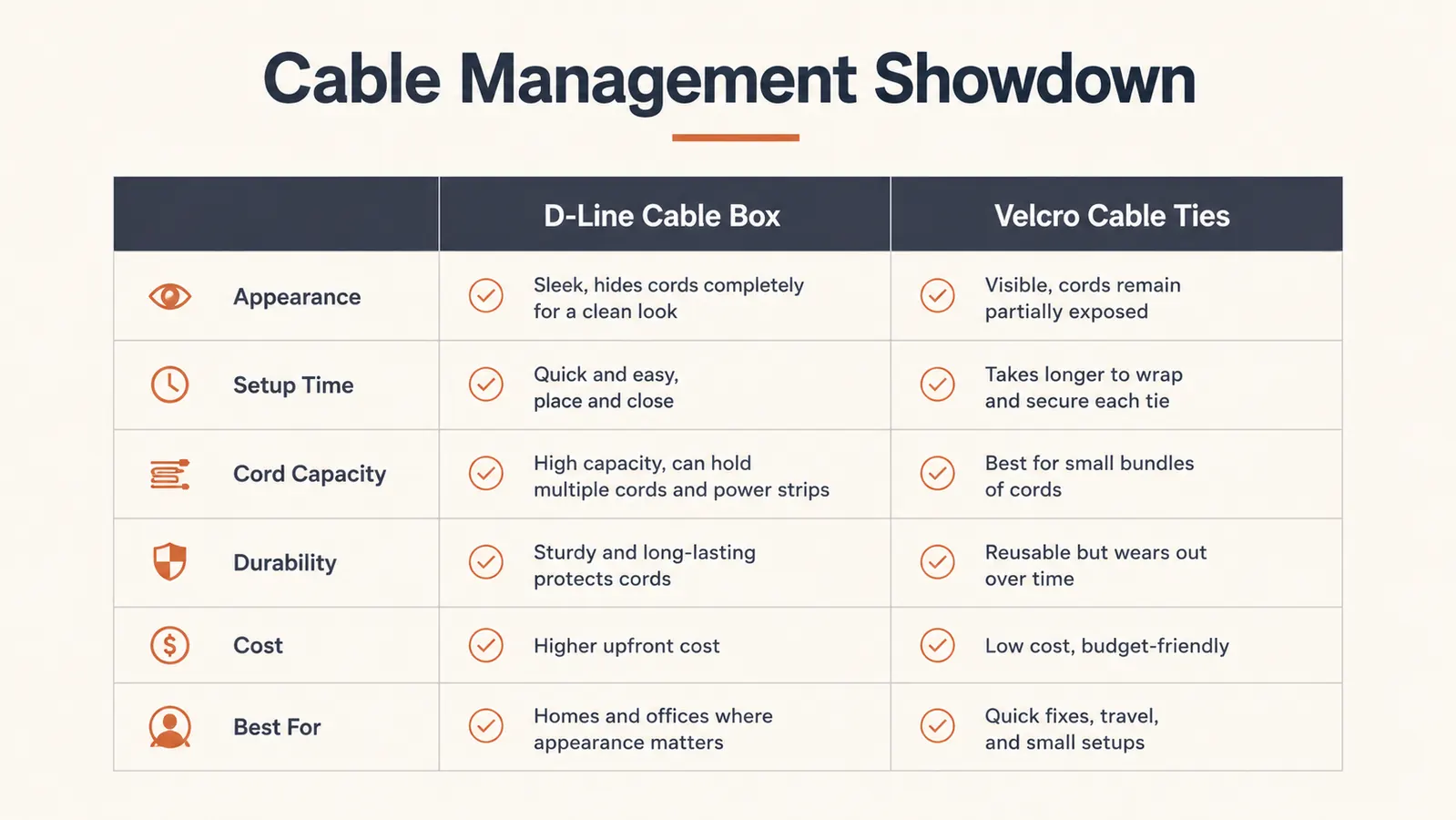
| D-Line Cable Management Box | Velcro Cable Ties | |
|---|---|---|
| Appearance from across the room | Cords completely hidden inside a solid plastic enclosure | Bundled cords still visible, just tidier bundles |
| Setup time | 5 to 10 minutes to route and close the lid once | 30 to 60 seconds to wrap each cable bundle |
| Power strip compatibility | Fits most standard 6-outlet power strips up to 15.7 inches | Works with any cord thickness, no size limits |
| Heat dissipation | Vented lid panels allow passive airflow; lid stays slightly warm but not hot | No enclosure at all; cords run fully open-air |
| Re-access to add or swap cables | Lift the lid, done in 10 seconds | Peel velcro, re-bundle, re-wrap after every change |
| Long-term durability | Hard ABS plastic holds its shape for years; clips do not stretch | Velcro backing degrades over 12 to 18 months; hooks catch on carpet fibers |
| Price | Check today's price on Amazon | Budget-friendly for a 50-pack |
| Best for | Permanent home office setups where the power strip lives in one spot | Travel kits, temporary setups, and bundling individual cables in a bag |
Where the D-Line Cable Management Box Wins
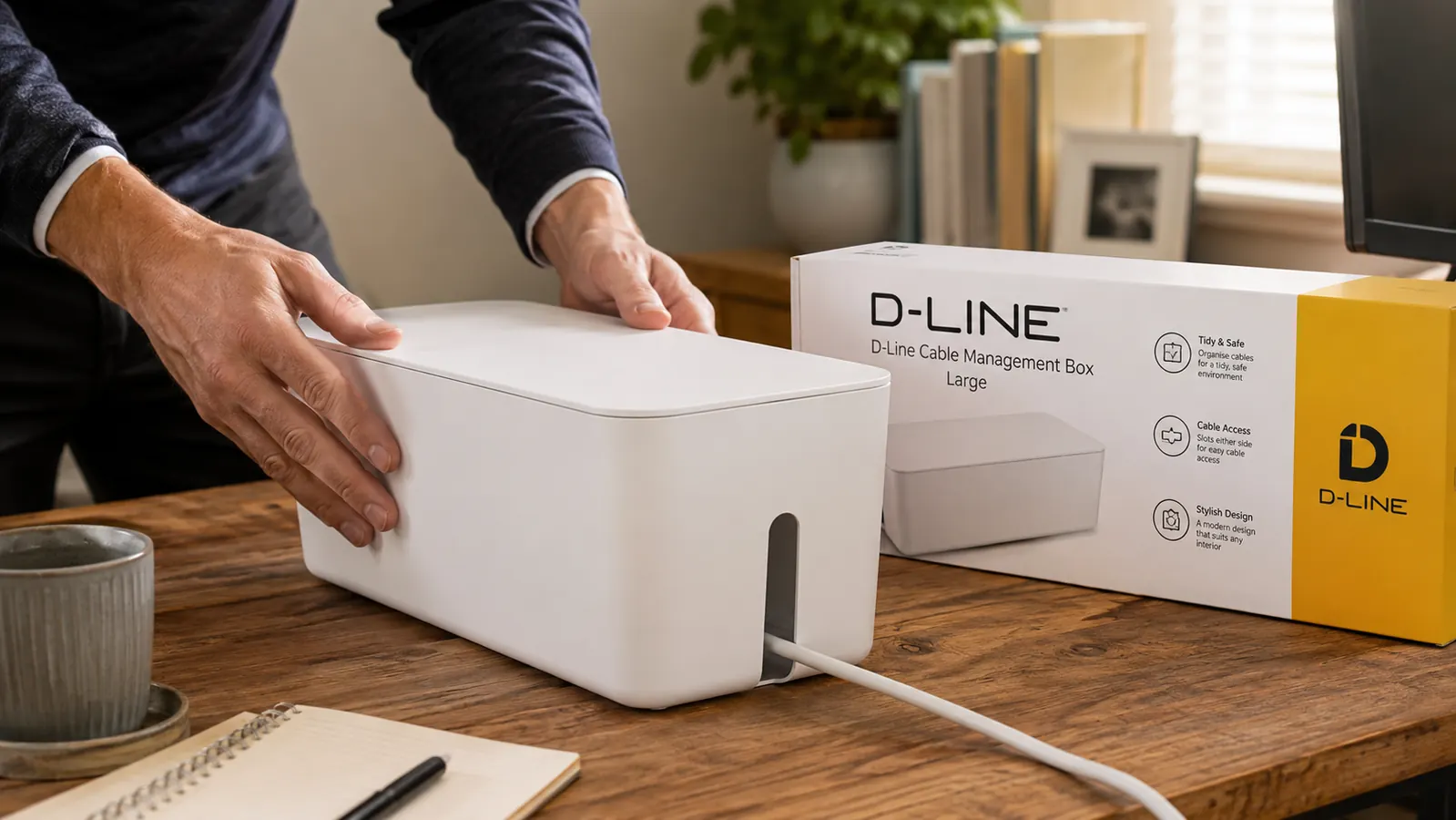
The core problem with visible cords is not just aesthetics. It is the mental load. Every time you sit down to work, your eye catches the tangle, and your brain registers it as disorder even if you stop consciously noticing it after a few weeks. The D-Line box eliminates the problem entirely because the cords are behind a lid. Your power strip, three or four chunky wall-wart adapters, and all the excess cable length go inside a single white or black enclosure that looks like a miniature storage container. From the angle of any webcam on a typical desk setup, the unit is invisible.
The design details hold up on close inspection too. The side cable entry slots are pre-cut and smooth-edged so cords do not get nicked over time. The snap-fit lid is firm enough that it does not rattle or pop open when you brush against it. I have had mine in use for five months and nothing has shifted. If you need to plug in something new, it takes about ten seconds to unsnap the lid, route the cord, and close it again. That is meaningfully faster than unwrapping and re-wrapping velcro bundles every time your setup changes.
Where Velcro Cable Ties Win
Velcro ties are not useless. They are just used for the wrong jobs by most people. The right job for a velcro tie is organizing a cable before it enters a management solution, or bundling the travel charger brick and cables inside a laptop bag so they do not unravel into a knot. They also work well for cable runs along the back of a desk where you want individual cords clipped to a cable raceway. In those scenarios, they are faster than anything else and plenty durable enough.
The problem starts when people treat velcro ties as the final solution for a power strip and its associated cables. You can bundle the cords neatly on day one, but six months later the velcro backing has collected carpet fuzz, the hook side starts catching on everything, and the bundles have loosened because people rotate the power strip or unplug something without unwrapping first. You end up with a semi-tidy mess instead of a clean one. Velcro has a useful life. The D-Line box does not degrade the same way.
Your power strip does not have to live in plain sight.
The D-Line Cable Management Box fits most standard 6-outlet strips and has 13,890 Amazon ratings to back it up. Check the current price and size guide before you order so your specific strip fits.
Amazon Check Today's Price on Amazon →Velcro ties fix the symptom. A cable box fixes the problem. The cord tangle is still there with velcro; you just tied it into a neater bundle.
What the Spec Sheet Does Not Tell You
The D-Line box has one size constraint worth knowing before you buy: the interior is designed for strips up to about 15.7 inches long and around 3 inches wide. Most standard 6-outlet strips fit cleanly. If you have a heavy-duty surge protector with a wide body or a 12-outlet strip with individual covers per socket, measure it first. I use an APC 6-outlet and it fits with room to spare, but a thick Tripp Lite model I tested was a half-inch too wide to close the lid fully. That is the single scenario where velcro ties remain the better option purely from a fit standpoint.
Heat is the other concern people raise. A plastic enclosure around a power strip sounds like a fire risk until you look at what is actually inside one. A power strip sitting at idle with a few device chargers draws almost nothing. The D-Line lid has a series of small vents running the length of the top panel, and in five months of daily use the exterior of mine has never gotten more than slightly warm to the touch under heavy use. Do not cram a power strip operating at near-capacity inside any enclosure, but for the average home office use case this is a non-issue.
Velcro ties have a different hidden downside that nobody mentions in the product listings: they catch on carpet. If your power strip lives on the floor near a carpeted area, the hook side of every velcro tie will grab fibers every time you nudge something. After a few months the hook side looks like felt and loses grip. On hardwood or tile this is less of a problem, but it is a real issue for most home offices.

Who Should Buy Which
Buy the D-Line Cable Management Box if your power strip lives in a fixed location on your desk or floor and you want the cords permanently out of sight with minimal ongoing maintenance. It is the right answer for any home office that has been set up for more than a few weeks and is not about to change. The one-time setup cost in time and money is worth it. This is also the better choice if your desk is ever visible on video calls, because no amount of velcro makes cords disappear the way an enclosure does.
Use velcro cable ties if you are dealing with individual long cable runs between specific devices, organizing cables inside a bag or drawer, or managing a temporary setup that changes frequently. They are also the right supplemental tool to use inside or alongside the D-Line box to bundle up excess cable length before routing it through the side slots. The two approaches are not mutually exclusive. I use both. The box handles the power strip; velcro handles the individual cables that come out of it and run to my monitor and laptop stand.
If you are comparing on price alone, velcro ties win by a wide margin. A 50-pack costs very little. But if you measure by outcome over 12 months, the D-Line box is the better value because it requires no maintenance, does not degrade, and actually hides the cords rather than organizing them into visible bundles. For a permanent home office, that trade is worth making.
See the D-Line box in the right size for your setup.
Available in white and black. Check the sizing details on the Amazon listing to confirm your power strip fits before ordering. Over 13,000 buyers and a 4.5-star rating make this one of the most field-tested cable solutions in this price range.
Amazon Check Today's Price on Amazon →